🌊 Aphrodite: Goddess of Love, Beauty, and Desire
Aphrodite is one of the most beloved goddesses in ancient Greek mythology.
Known for her beauty and passion, She represents love in all its forms.
She appears in countless myths, poems, and artworks across centuries.
🐚 Where Was Aphrodite Born?
She was born from sea foam near the island of Cyprus.
She rose from the ocean, fully formed and breathtakingly beautiful.
Waves carried her to the shore, where she first stepped onto land.
This magical birth makes her a goddess of sea and sky.
The city of Paphos in Cyprus still honors her as its patron.
💖 What Does Aphrodite Represent?
She symbolizes romantic love, beauty, fertility, and feminine energy.
People prayed to her for charm, desire, and emotional connection.
She was also linked with sensuality, marriage, and passion.
Her power could bring hearts together—or stir intense longing.
She embodied both the light and storm of love.
📜 Aphrodite in Ancient Myths
She often appeared in stories with gods and mortals.
Though married to Hephaestus, she loved Ares, the god of war.
She guided lovers, caused rivalries, and even sparked the Trojan War.
Wherever she appeared, beauty and drama followed.
🏛️ Worship and Temples of Aphrodite
Aphrodite was worshipped across Greece, especially in Knidos, Corinth, and Cyprus.
Temples in her honor were filled with flowers, music, and prayer.
People offered gifts hoping for love, fertility, and happiness.
Festivals for Aphrodite were joyful, colorful, and often sensual.
🏺 Aphrodite in Knidos: The City That Loved Her
Aphrodite wasn’t just worshipped in Knidos—she was adored.
In the 4th century BCE, sculptor Praxiteles gifted Knidos her statue.
It was more than marble—it was divine presence made visible.
Her temple stood open to the sea, welcoming all who sought love.
🌀 What Happened in Knidos?
The goddess blessed marriages, healed hearts, and inspired artists.
Pilgrims brought flowers, perfumes, and prayers to her temple.
Fishermen claimed to see her reflection in the waves.
They believed she calmed storms and protected sailors at sea.
🗿 The Statue That Moved Hearts
Visitors said the statue seemed alive, with warm eyes and a knowing smile.
She held a towel, as if caught mid-bath—divine yet human.
It wasn’t just art. It was Aphrodite.
✨ Her Legacy in Knidos
Aphrodite turned Knidos into a center of love and beauty.
Poets, travelers, and lovers came from far away.
Even today, her spirit lingers in the breeze and sunlight.
In Knidos, she still feels real.
You might want to see the ancient city Knidos yourself wşth a guide you can click on the link below for more information or to book this excursion: https://experiencedatca.com/trip/guided-trip-to-knidos/
👩👧 Aphrodite and Her Children – Love’s Divine Legacy
Aphrodite wasn’t only a lover—she was a mother.
Her children were powerful symbols of love, passion, and transformation.
💘 Eros – The Spark of Desire
Eros, son of Aphrodite, flew with golden arrows of love.
He made mortals and gods fall deeply and instantly.
His love story with Psyche is legendary.
Though youthful, Eros held ancient wisdom of the heart.
⚖️ Harmonia – Peace Born from Passion
Harmonia was her daughter with Ares.
She brought calm and balance after the chaos of love.
She married Cadmus and received a magical, cursed necklace.
Her name reflects unity and beauty after conflict.
🛡️ Aeneas – The Hero of Two Worlds
Aeneas, son of Aphrodite and Anchises, was half-divine.
She protected him during the Trojan War with fierce devotion.
He survived Troy’s fall and led people to Italy.
Romans saw Aphrodite (as Venus) as their divine ancestor.
🔥 Phobos and Deimos – The Shadows of Love
Twin sons of Aphrodite and Ares, they embodied fear and terror.
They rode into battle spreading chaos beside their father.
Though darker, they show Aphrodite’s emotional depth and duality.
🌿 Priapus – Guardian of Growth and Fertility
Priapus, another of Aphrodite’s children, protected gardens and vineyards.
He symbolized life’s wild, natural energy.
Though playful and rustic, he represented fertility and abundance.
👡 Aphrodite and the Flying Slipper: A Myth or a Message?
In Turkey, every child knows the warning: the slipper is coming.
A mother waves it with fury—and love.
That flying slipper is tradition, power, and discipline all in one.
But did you know even Aphrodite once raised a slipper?
🇬🇷 A Greek Vase With a Surprise
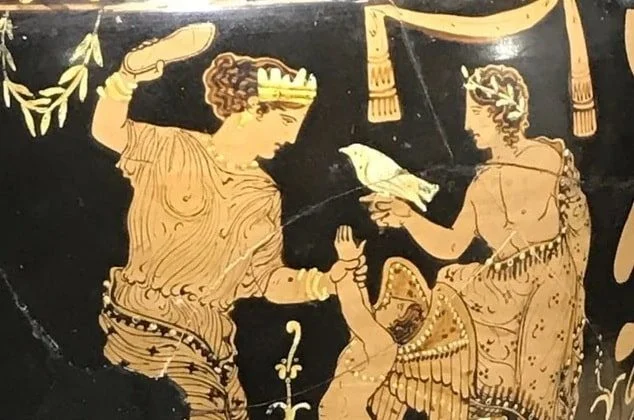
Historians discovered an ancient Greek Vase from around 2nd century BCE.
It shows Aphrodite—not with a dove or rose—but a slipper.
She’s not lounging or posing. She’s raising her sandal mid-motion.
Why would the goddess of love hold a shoe?
🏛️ Aphrodite in Art and Humor
Her son Eros was being naughty ……
👩👧 The Motherly Parallel
In Turkey, mothers lift slippers when kids cross the line.
It’s half discipline, half dance—always filled with heart.
Just like Aphrodite, they warn: love doesn’t mean losing power.
That shoe speaks louder than words ever could.
👡 A Symbol of Feminine Strength
Aphrodite wasn’t just beauty—she had boundaries, strength, and boldness.
Her raised slipper says: Don’t mistake charm for weakness.
Even goddesses have limits—and sandals ready to fly.
💬 What the Vase Still Tells Us
The vase mixes humor, power, and myth in one scene.
It reminds us: even divine love needs respect.
Aphrodite knew when to smile—and when to defend herself.
And just like Turkish moms, she never missed her aim.
🌹 Final Thoughts
Aphrodite wasn’t just a goddess of desire—she shaped lives, cities, and empires.
Through her children, she left behind a powerful, emotional legacy.
In every myth, she reminds us that love is sacred, transformative, and eternal.
Even now, her presence lingers in art, poetry, and the soft sea breeze.
To love is to know Aphrodite—and to feel her timeless spark within.